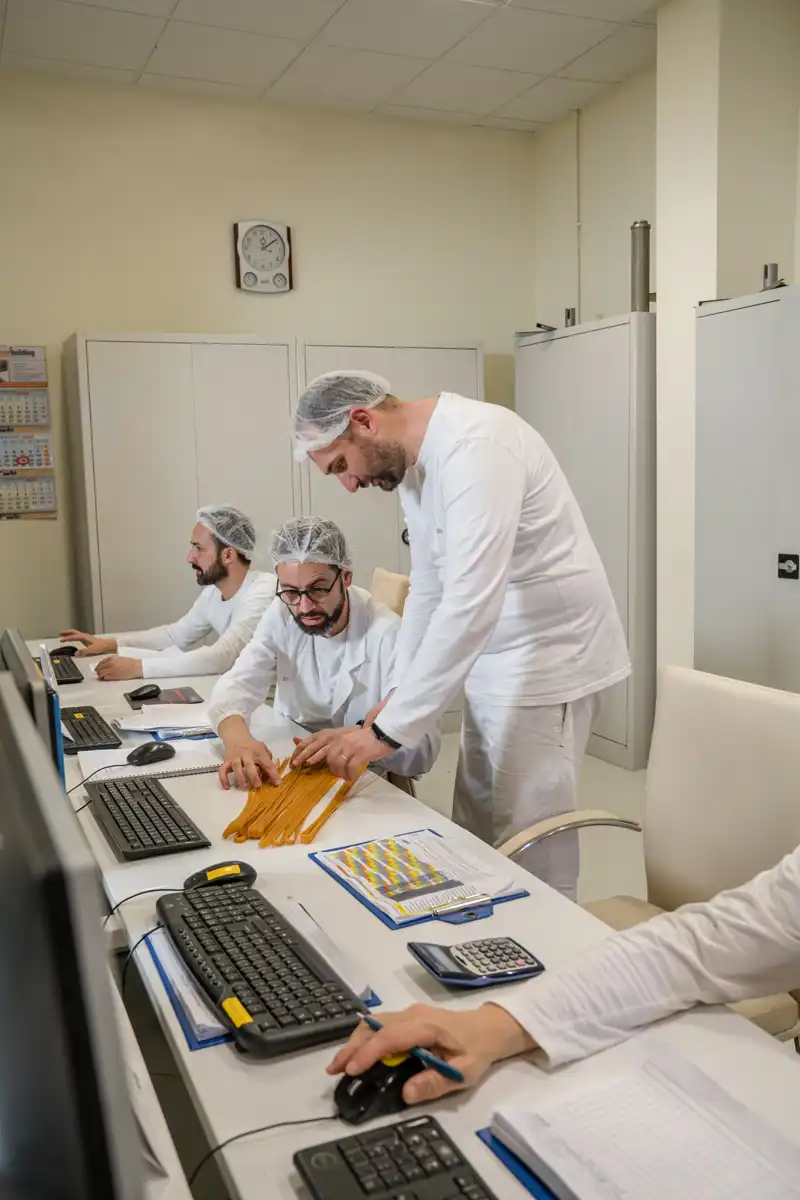
The Quality Control Department is the glue between Andriani’s many departments.
The staff working in this department monitor the entire production process through constant communication with other company departments, and careful examination of the finished product.
Control of raw materials
The Quality Control Department has 6 staff members: 4 in the laboratory, 1 quality control officer, and 1 staff member (MT) who oversees both units.
All incoming raw materials in tanks, whether in the form of grains or flour, arrive in the laboratory after being sampled, and undergo an initial gluten test.
In the case of pulses, tests for soy and mustard are also performed before opening the tank, as well as the gluten test.
On top of the standard tests, the raw materials are examined for grain size, mycotoxins, humidity and colour.
Once all quality tests have been passed, the tank is opened and the product is sent to the mill.
The next phase is milling, and more controls are performed in this department, taking a sample which is sent to the laboratory to be examined for gluten, soy, mustard, grain size, mycotoxins, humidity and colour.
Control of finished products
Control of finished products follows a precise procedure: a member of the production department takes 2 samples of the finished product for all lots and all recipes of each product from different time periods.
The following tests are then performed:
DIMENSION TESTS: depending on the format (in the case of penne): ridge thickness, cleft thickness, diameter, length.
SENSORY TESTS (cooking test): to check chewiness, smell, flavour and definitive cooking time.
If the result of the tests conforms to requirements, the pasta is sent for packaging.
Packaging control
The following tests are performed on the packaging line:
Integrity of packaging
Packaging label
Opening of the packaging
Glue on the closures of the packaging
Lot
Metal detector
If the result of the tests on all parameters conforms to requirements, the product is ready to be sold.
Andriani carries out constant, precise controls on the entire process, to guarantee the production of a safe, top-quality product.
The dedicated department systematically archives the samples of every lot of raw materials, which stay on the database for 1 year, and the samples of finished products, which stay in the archive until the product’s expiration date.
This data collection facilitates traceability and the management of any possible complaints.
Maintenance
Maintenance is a system that operates across all departments of Andriani’s facilities.
Maintenance staff are in charge of both new projects and interventions on existing systems and machinery, and manage all technical activities relating to pasta production.
The maintenance service is systematically tracked on a management system, to guarantee the traceability and constant control of any possible faults or malfunctions.
There are procedures for ordinary and extraordinary maintenance. For the latter, we use a versatile, flexible approach that allows us to resolve the problem promptly and efficiently.
The maintenance team is made up of 15 staff members, who work closely together, communicating regularly.
The technical training and refresher process for all operators is very important, as well as active participation in trade fairs and industry events.
Predictive maintenance
An artificial intelligence project is underway, in collaboration with the university: from analysis of an acceleration in vibrations, it is possible to predict in advance the possibility that a machine or one of its parts may malfunction.
This way, it is possible to organise production based on these calculations, with a huge advantage in terms of optimisation and improvement of efficiency.
Autonomous maintenance
The department is trained to ensure that small routine repairs can be performed directly by the operator on the machine.
This way, maintenance technicians can dedicate themselves to larger interventions.